

There are only a few days left to sign up for plants! The deadline has been extended to Monday, April 6th, at midnight.
If you want to request free native pollinator plants for your school, fill in the request form https://www.surveymonkey.com/r...
Supplies are limited. Selected schools will be notified by the end of April and plant pick up events will take place near the end of May.
Tell your teacher friends and request plants today!

Un message en français suit.
Bienvenue! WELCOME to the WILD Spaces classroom!
This is an online classroom hosted by TakingITGlobal.
WILD Spaces is a CWF education program that aims to connect educators and children to nature. Join us on our journey of helping students to engage with their own WILD Spaces!
1. Connect with your outdoor space and foster a deeper relationship with nature.
2. Learn about your local wildlife, habitats, and ecological needs.
3. Plan improvements to your space to make it wilder and to support pollinators and biodiversity. *Hint* Sign up to request plants and you may be one of the lucky schools who receives free native pollinator plants. Supplies are limited, so have a back up plan of where you can by native plants in your area. Then send us your plan!
4. Act: Put your plan into action. Maybe you received free plants from CWF or purchased them from your local plant nursery, now it's time to put them in the ground and watch your WILD Space flourish.
5. Reflect: Once you've made some changes in your WILD Space, first, celebrate your hard efforts! Second, go back to the questions we asked when we were connecting to our WILD Space and see what has changed.
Wildlife is everywhere! Every schoolyard outdoor space is a WILD Space. We share outdoor spaces with a wide variety of plants and animals.
CWF is connecting with native plant nurseries across the country to bring pollinator plants to schools. Tell us about your garden plans, and you could receive 40 pollinator-friendly plants native to your province. To be eligible for plant giveaways, subscribe to our monthly WILD Spaces eblasts and fill out the request form.
Sign up today to follow the journey, access extra educational tools, and join a growing network of schools making space for wildlife.
Have a read through this classroom as well as our online Learning Library for activities, lesson plans and more about pollinators and their habitat.
If you have any questions, please send an email to [email protected].
Enjoy!
It’s Not Too Late to Request FREE Native Plants!There’s still time to apply for a chance to receive free native pollinator plants through the WILD Spaces program. Request your plants >
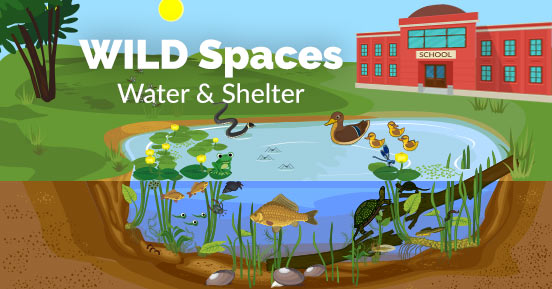
Every wildlife‑friendly space needs food, water, shelter and earth-friendly gardening practices (no pesticide use).
Now that you’ve connected with your outdoor space and started planning your native plant garden, it’s time to focus on two essential habitat elements that help wildlife thrive: water and shelter. This month, let’s build on the foundations you’ve already created.
Provide Water in Your WILD Space
Water is one of the most important components of any wildlife‑friendly garden. It’s needed for drinking, bathing, cooling down and staying healthy. Even simple water features can make your WILD Space more welcoming to wildlife. Remember to refresh water every few days and keep containers clean to prevent bacteria and mosquito larvae.
Ways to Provide Water in Your WILD Space
Water sources that you can purchase or make
- Birdbath — A birdbath in a shaded spot helps wildlife drink and bathe while keeping water cooler for longer.
- Shallow dish with perching stones— Ground‑level dishes support birds and insects. Add a few stones or gravel for safe footing.
- Butterfly puddling dish/area — A shallow dish with moist sand, compost or soil gives butterflies access to water and minerals.
- Small pond — A simple pond supports amphibians, insects and other wildlife. Ensure edges are sloped or provide stones or logs so animals can climb out easily.
- Recirculating stream or mini‑waterfall — Running water adds sound and movement that attracts wildlife and can support a wider range of species.
Natural water sources
- Water garden — A planted area designed to hold or manage water, similar to natural pond edges.
- Rain garden — A shallow, vegetated basin that collects and filters rainwater runoff.
- Stream / Spring / River / Lake — Flowing or standing natural waters provide habitat for amphibians, insects, and many species of birds.
- Wetland / Seasonal pool — Temporary or permanent shallow wetlands support amphibians, insects, and migrating wildlife.
Creative and Low-Cost Water Ideas
- Upcycled container dishes — Old lids or trays can become shallow water sources.
- Rock with a natural depression — A flat stone with a dip can hold small amounts of water after rain, similar to natural puddles.
- Clay pot saucers — Saucers make excellent shallow basins for insects and birds.
Provide Shelter in Your WILD Space
Shelter is just as important as water. Wildlife needs places to stay warm in winter, cool in summer, hide from predators, and nest or rest throughout the year. Below is a wide range of shelter features your schoolyard can incorporate.
Ways to Provide Wildlife-Friendly Shelter in Your WILD Space
Vegetation-Based Shelter
- Potted plants — These are great for schools with limited digging space.
- Ground cover — Ground cover provides cool, moist hiding places for insects and amphibians.
- Leaf litter — A critical microhabitat for insects, leaf litter also supports soil health.
- Dense area of native grasses/perennials — Clusters of perennials, ferns, and grasses give small creatures places to hide.
- Vines — Climbing plants create vertical habitat and nesting cover.
- Meadow/prairie plantings — Tall grasses and wildflowers offer shelter and food.
- Host plants for caterpillars — These plants are essential for butterfly life cycles.
- Hollow plant stems — These offer nesting habitat for native bees.
- Evergreen trees/shrubs — Trees and Shrubs provide year‑round cover from weather.
- Deciduous trees/shrubs — These create layered habitat for birds and insects.
Structural Natural Shelter
- Rock pile — This feature creates cool, shaded micro‑habitats for insects and amphibians.
- Brush pile / Log pile — Piles offer excellent shelter for insects, amphibians and small mammals.
- Open sunny ground for solitary bees — Many solitary native bees tunnel into bare soil, making ground beneficial.
- Burrow — Natural underground hideaways used by small mammals and amphibians for shelter and safety.
Human-Made Shelter Structures
- Bug hotel — This structure supports solitary bees and beneficial insects.
- Bird nesting/roosting box — These boxes can be created at home, or you can opt to provide the material for the birds to make their own.
- Bat house — These houses provide summer roosting habitat for bats—here’s a video tutorial.
- Toad abode — These homes give toads a place to rest and eat.
- Snag (standing dead tree) — Snags supports cavity‑nesting birds and insects (when safe to maintain on site).
A Note on Maintenance
Remember: Keeping your garden free of pesticides ensures these shelter areas remain safe for wildlife and the insects many animals depend on for food
Thanks for Growing With Us!
Your efforts are making a real difference for local biodiversity. By offering water and shelter, you’re helping your WILD Space become a living, thriving habitat — and a powerful learning environment.
Let us know how your garden is evolving — we love seeing photos and stories from your schoolyard!
If you discovered this blog on our website, be sure to sign up for the WILD Spaces e‑blast. You’ll receive monthly updates, next‑step reminders, and resources featuring each month’s highlighted pollinator — everything you need to stay inspired and keep your garden growing strong!
Did you know that native plants need less water, less maintenance, and have spent thousands of years evolving alongside local pollinators?
That’s what makes them the perfect foundation for your WILD Space! We’re now on Step 3 of your journey: planning your native plant pollinator garden. If you missed the first two steps, don’t worry! You can catch up here >
Where to Start?
Before starting your garden, you need to decide which native species you’re going to plant, where your garden will be located, and your plant layout. Let’s start by learning which plants are native to your area, what their characteristics are, and organizing them in a plant chart.
1. Create a Plant Chart
Here is an example chart from a native plant nursery in the Ottawa area.
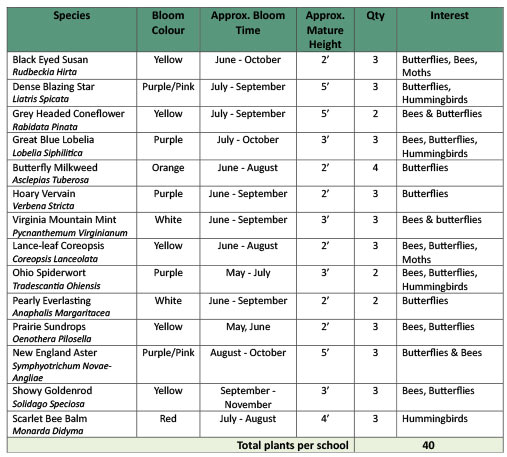
Visit the Canadian Wildlife Federation’s Native plant encyclopedia and look up the plants that are native to your province. Using the Plant Chart template, create a table that includes the following:
- Name – common and scientific
- Colour
- Bloom time
- Height
- Width
- Attracts what wildlife
2. Design Your Garden Layout
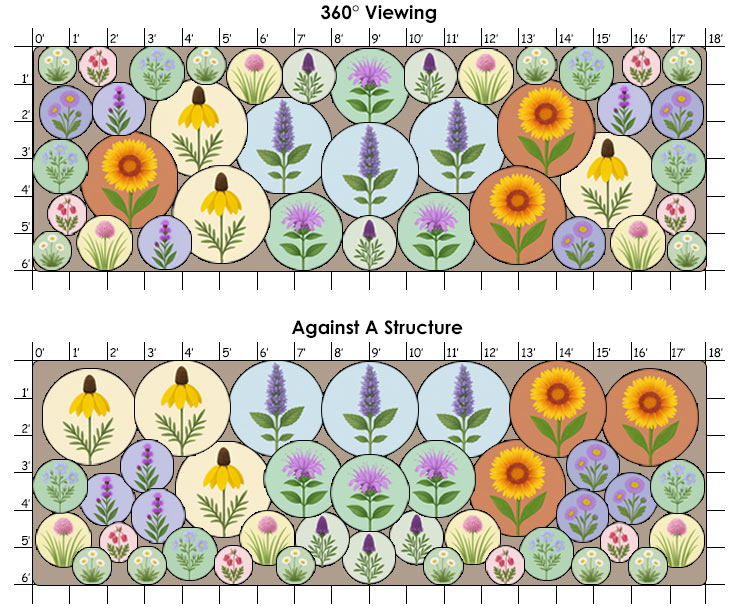
Once you understand the characteristics of each plant, you can start planning where they will go in your garden. Begin by deciding both the shape of your garden—round, square, rectangular—and the location of your garden—freestanding or against a structure. These choices influence how your layout will take shape. For example, in a garden against a structure, taller plants should be placed at the back, while in a freestanding garden, place the tall plants in the centre as not to block the view of the shorter plants. See the example above for diagrams of a freestanding garden and of a garden up against a structure.
Download a garden-design template to get started on your garden layout today.
3. Submit Your Plan & Request Plants
Now that you’ve completed your plant chart and garden layout, send your design to [email protected]. Submissions will be accepted until March 31, 2026
The Canadian Wildlife Federation works with native plant nurseries across Canada to give schools free pollinator plants. The sign-up for plants will be open until March 31, 2026. Availability of plants is limited. If you are to receive plants, you’ll be notified in April, 2026 about the date, time and location of the pick-pick event.
You’re Ready to Grow
Your WILD Space is well on its way—every native plant you choose helps local wildlife thrive! For quick tips to keep your garden growing strong, check out our Basics of Wildlife-Friendly Gardening handout.
If you discovered this blog on our website, be sure to sign up for the WILD Spaces e‑blast. You’ll receive monthly updates, next‑step reminders, and resources featuring each month’s highlighted pollinator — everything you need to stay inspired and keep your garden growing strong!
Did you know there will be a new blog every month from January to June in 2026?
Check out the January blog that will help you Connect and Learn about your WILD Space.

Welcome to a new year of exploration with the Canadian Wildlife Federation’s WILD Spaces Program!
We’re so pleased to have you join us on a journey that empowers students from Grades 3–6 to build meaningful connections with the natural world right outside their door.
How do you know if your space is a WILD Space?
- Every space is a WILD Space
- Wildlife if everywhere
- WE are PART of nature
- We share spaces with many different plants and animals. What can you find in your WILD Space?
Step 1: Connect With Your Outdoor Space
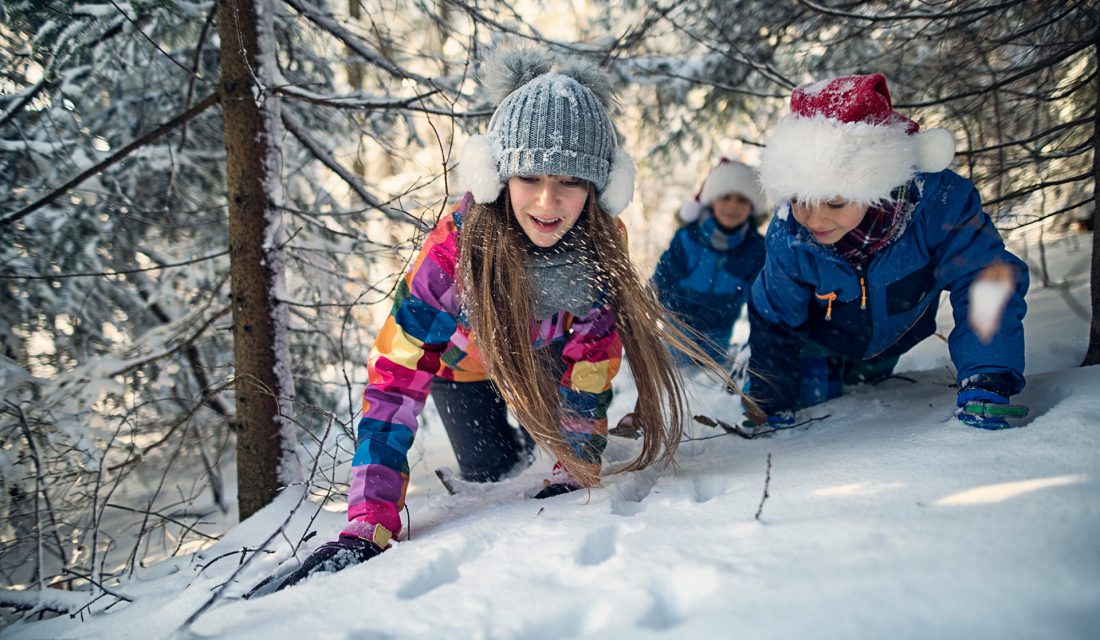
Encourage students to explore their surroundings and ask:
- Is my space a WILD Space?
- What do I notice? What’s missing?
- Can I find nature here? Where?
- Who or what shares this space with me?
Step 2: Learn About Your WILD Space
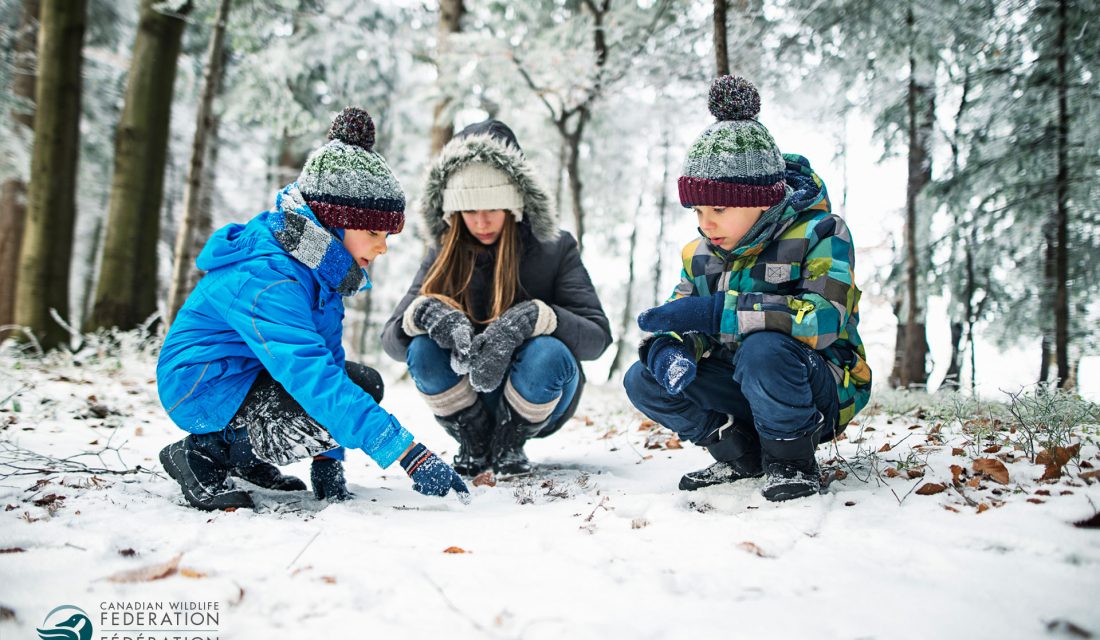
Dive deeper into local wildlife and habitats:
- Check out our WILD Webinar “Gardening for wildlife” or short video on gardening for wildlife.
- Find lesson plans, activities, and more in the Learning Library. The lesson plans on Plant Anatomy and Life Cycle & Pollination are two great places to start.
- Take photos of animal tracks in the snow and upload them to iNaturalist, or look them up using the Seek app.
- Discover species in your area using Hinterland Who’s Who (HWW), or through one of our partner organizations.
- Sign up for the WILD Ed Newsletter and you’ll find out January’s topic is all about how wildlife adapts in winter.
Let’s make 2026 a year of discovery, stewardship, and connection.
Looking for some professional development? Check out our WILD Education experiential education workshops.
Stay tuned for more resources, plant giveaways, and student action projects throughout the year!
Your plants will soon find their way to your school!


Choose one or all of these wild webinars!
Join experts from the Canadian Wildlife Federation for a captivating excursion into the world of Canadian wildlife during National Wildlife Week (April 6-12)! From monarch butterflies to whales, you’ll learn about some of Canada’s most fascinating migratory species, get an up-close look at CWF’s conservation research on the ground, and discover ways you can help support wildlife conservation and preserve Canada’s natural heritage by taking action at home and in your community.
Each day will feature a different specialist sharing their expertise on Canada’s migratory species and celebrating the rich biodiversity that makes Canada such a special place. Mark your calendar, be sure to sign up for all five sessions, and let’s work together to protect the wildlife that call our great nation home!
Thank you for every action you take to help conserve our precious Canadian wildlife.
It's that time of the year to request perennial plants for your pollinator garden projects. The WILD Spaces program supports schools and community groups to create a pollinator-friendly habitat. Requests are randomly selected and you will be notified if your project would receive plants. You can expect delivery by mid-May.
Click on request plants!

As we celebrate this day, connecting with nature helps us deepen our understanding of the environment and uncover ways to better protect endangered species.

One of the many benefits of healthy soil is that it provides essential nutrients for our plants, which in turn supports the environment and wildlife. As we commemorate World Soil Day, we trust that you have found inspiration to consider soil-focused initiatives for your school gardens.


Hi there,
Have you ever wondered where our native pollinators such as bees, butterflies, hummingbirds overwinter? Our garden allies have adapted incredibly to the changing temperatures and managed to survive and stay warm. While some migrate to warmer temperatures — Mexico and Central America, others overwinter here in the leaf litter, soil, logs, plant stems, woods, and in other crannies.

When the winter months are over, we get to see our garden buddies again! What is exciting is that you and your students can help create a pollinator-friendly habitat to welcome our pollinators out of winter and provide them with the much-needed nutrients. A garden with natural sources of food, water and shelter.
The Canadian Wildlife Federation’s pollinator conservation program, WILD Spaces, supports elementary schools and groups with pollinator-friendly perennial plants every year. WILD Spaces encourages educators and students to spend more time outdoors as they adapt their gardens to a pollinator habitat. You can learn more about the program by watching this video: JUST KEEP GROWING - YouTube.

Request plants for your garden project today and you could be selected at random for free plants!

Hi Educators, we look forward to hosting you and your classroom on the Pollinators and Meadow Habitat Webinar. Join us April 6, 2023. Time 12 p.m. to 1 p.m ET!
Pollinators play an important role in our ecosystems and food production, but they face many threats such as habitat loss and pesticide. Join us as we talk about who the pollinators are and what habitats they need. We will also explore what you can do to help pollinators!

The speaker will be Tracey Etwell a Restoration Ecologist on the Rights-of-Way and Grasslands Project Teams at the Canadian Wildlife Federation. She has been lucky to study plants and animals across Canada. She helps to build new habitats for these species. In recent years, she has been working on habitat for pollinators, such as native bees and Monarch Butterflies in Ontario.

Hi Educators,
I hope you had a wonderful start to a school session this fall. As we wrap up the year for the holiday break, we are thankful that you have been a part of the WILD Spaces program inspiring your students to do more for the pollinators and other wildlife in your schoolyard and beyond.
As we approach the holiday season, there is yet another opportunity to engage in a nature-based activity. Birdwatching and counting are fun activities that brings us closer to our environment while appreciating the uniqueness of our feathered friends.

You and your students can support our bird population and scientific researchers who rely on citizen scientists like you for data to advance their research on migration patterns of our bird population and their health. Through bird watching and counting, we learn about the local birds in our area and possible threats to their habitat.

Is your classroom interested in bird conservation? You can access the Holiday Winter Bird Activities by logging into the WILD Spaces classroom.
We wish you all a happy and fun-filled holidays!
Hi Educators,
Welcome back to school! We hope you had a beautiful summer. Hopefully you had the time to enjoy the nice weather and spend quality time with friends, family and nature.
We welcome you back to the WILD Spaces classroom. If you are a new member, we welcome you on board. This program is all about connecting students and teachers with nature! This year the program comes with many different resources such as: lesson plans, activities, quizzes and Power Points. All of these resources should equip you with what you need to connect students to nature as they learn about the seven kinds of pollinators in Canada and how to support them.
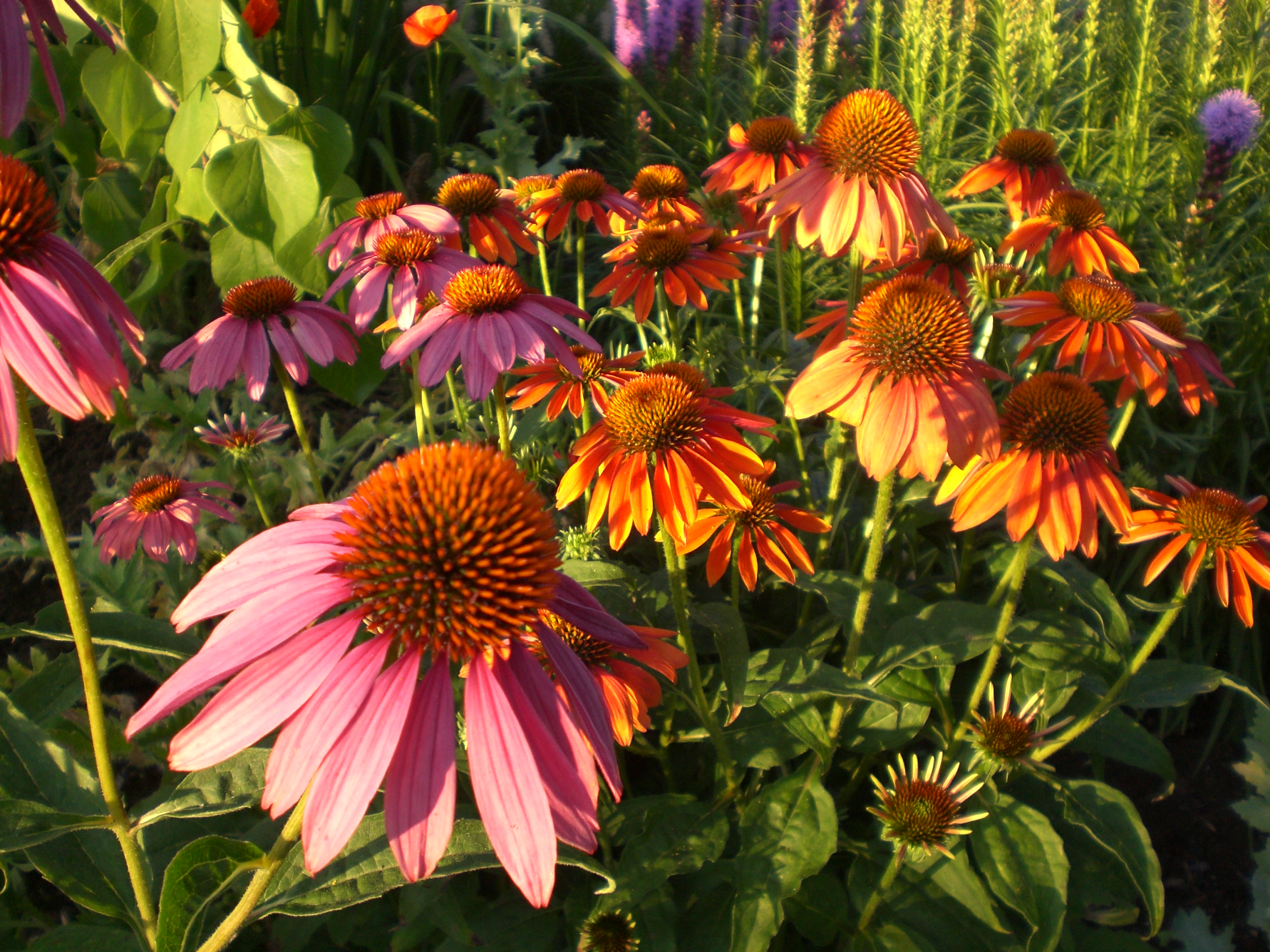
You can even register to receive free native flowers to plant in your school garden. We also encourage you to get your school garden certified with the Canadian Wildlife Federation.
If your school garden meets the criteria for a wildlife-friendly garden, you and your students can apply this fall or next spring to have your garden certified as wildlife-friendly habitat. Every school garden certified gets a free CWF certification sign (while supplies last). The signs will look lovely in your gardens and will be a good way to encourage students to plant wildlife-friendly gardens at home.

In order to certify your garden, you can follow this link: Canadian Wildlife Federation: Garden Habitat Certification Form: Info (cwf-fcf.org). Before certifying your garden, it is a good idea to understand the basic needs for wildlife-friendly gardening. You can also sign into the WILD Spaces classroom for activities on garden certifications.
Have you had the chance to look at how your garden has evolved over the summer? If so, we would love to see photos of your gardens! Please share the photos of your garden via the WILD Spaces platform.
We look forward to seeing how your school garden evolved during the summer months.
Welcome back; we will keep in touch soon with new resources and fun activities for groups of all ages!
Thank you and greetings from the Canadian Wildlife Federation.
Hi Educators,
Thank you for being a part of the Canadian Wildlife Federation school-based pollinator conservation program – WILD Spaces. Your passion to help raise the next generation of conservationist whilst caring for our natural environment and wildlife is rewarding!
The WILD Spaces program is all about connecting educators and students with nature as they learn about pollinators, create habitat, observe and record the wildlife that visit their school gardens.

This school year, we led a WILD Spaces webinar series and elementary students from within Canada and beyond joined us online to learn about the seven different types of pollinators in Canada, how to turn our scraps to soil and highlighted Elizabeth Ballantyne and Evergreen school’s pollinator gardens in Canada. Our guest speakers shared interesting stories about their school gardens and the tremendous teamwork of their students. You can find the webinars and other educational videos on CWF’s YouTube Channel.

Not only did students learn about pollinators, but the Canadian Wildlife Federation also distributed 5,200 pollinator-friendly perennial plants to 130 schools across Canada to facilitate hands-on learning!

With the help of teachers and students, pollinator gardens were created in schools providing nectar and pollen-rich habitat for our pollinating friends!

We love to celebrate your students’ efforts as they provide food, water and shelter for wildlife and maintain their school yards in an earth-friendly way. You and your students can apply for CWF Garden Habitat Certification, when successful, your school garden would receive an official recognition as a wildlife-friendly habitat. Apply here

And with the iNaturalist app, your students can contribute to the growing knowledge of native plant gardens and wildlife that visits your school yard. Sign up for the CWF's Gardening for Wildlife iNaturalist page account under your school’s name, your students can identify, record and learn more about the wildlife around them. You can find step-by-step instructions on how to create an iNaturalist account on this link. We look forward to your wildlife stories and photos.
Thanks again for a wonderful school year.
Have a lovely summer!
Hello Educators,
Canadian Wildlife Federation is offering free pollinator plants to 200 schools and community organizations.
We’ve made it easier for you to request pollinator-friendly plants for your school or community gardens. To make a request, please go to ‘forms’ under ‘classroom tools’ to express your interest in pollinator plants.
We’re very excited to see your students contribute to wildlife conservation by planting for pollinators.
If your school or community organization is randomly selected for free plants, you will receive an email by mid-April to confirm your request.
If you have any questions, please send an email to [email protected].
Thank you,
Eneze
Q: How do I add my child/students to this classroom?
A: Click on “participants” and then hit the orange “add students” button on the right hand side.
Q: The activities are too simple/advanced for my child/students, can we still participate in the program?
A: Yes! If the activities are too advanced or simple for your group, feel free to adapt them to suit your needs and please don’t hesitate to share your students’ work on this platform. Educators with younger students can post on behalf of their classroom if they like.
Q: Does my child/students have to complete all the activities?
A: No. You can select which activities you would like to do with your students. To get the most out of the program we suggest going through each activity in order.
Q: How can I start a discussion on this platform?
A: Click on “discussions” and then hit the orange “post new thread or create forum” button on the right-hand side.
Q: How many pollinator plants should each school or community organization expect?
A: Ten CWF pollinator kits for a total of 40 pollinator-friendly perennial plants.
Q: What is the timeline for the plant’s arrival?
A: Tentatively last week in May or early June.
If you have any additional questions, please send an email to [email protected].

Q: How do I add my child or students to this classroom?
A: Under ‘Classroom Tools’ on the bar to the left, click on ‘Participants’. Then look for the orange “add students” button (should be the middle one of three) and click on that. Follow the instructions and write down the usernames and password(s) you create for your child or students.
Q: The activities are too simple/ too advanced, can we still participate in the program?
A: Yes! If the activities are too advanced or simple for your child/students, feel free to adapt them to suit your needs and please don’t hesitate to share your students’ work on this platform to inspire others. Those with very young students can post on behalf of their class, if they like.
Q: Does my child or student have to complete all of the activities?
A: No. You can select which activities you would like to do. To get the most out of the program we suggest going through each activity in order.
If you have any additional questions, please send an email to [email protected].
